Product Marketing Is Your Biggest Growth Lever. Most Founders Underinvest in It.

AI has made building products easier, faster, and cheaper. An idea that took months to prototype now takes a week. And yet open Reddit on any given day and you'll find founders sitting on working products with no customers.
Building was never the hard part. I don't think anyone becomes a founder because they wanted to build a product. They start because they saw a problem before other people did, and found a way to solve it so others could benefit too. Look closer at that conviction and there's always an emotion underneath it, something the buyer feels every day: the frustration of not knowing why the number moved, the dread of an audit, the exhaustion of a tool nobody on the team can use without help. That feeling is what the founder set out to remove. And yet the journey gets misplaced onto features instead of the buyers those features were built for, and the emotion that started it disappears from the story.
Growth is built on one belief, not a feature list
Strip away the roadmap and every high-growth company is really selling one core belief, repeated everywhere a prospect looks.
For a decision intelligence platform, it's the context layer: the promise that you'll finally see the "why" behind the number, not just the number. For HR tech, it's ease of use, the relief of a tool your least technical manager can run without opening a ticket. For fintech infrastructure, it's compliance and reliability, the quiet assurance that money moves and nothing breaks. For a compliance platform, it's trust itself, proven continuously rather than claimed once.

Notice what each of those actually is. Not a capability, a feeling. Relief. Assurance. Clarity. Confidence. The feature list is how you deliver it.
That belief isn't a tagline either. It's what bigger deals, multi-year contracts, and renewal without a fight depend on. Every one of those outcomes traces back to a buyer believing, in their gut, that your one core claim is true. Finding that belief and ensuring it’s reflected across every claim, conversation, and conversion is the core
of the success of your business.
Product marketing is the thread that connects belief to build
The reason the belief gets buried under features is that most companies never fund the function whose whole job is keeping it visible. Product marketing routinely gets 10 to 15% of marketing spend, treated as a support function that documents what product and sales already decided. A nice-to-have, staffed last, cut first. That allocation is a mistake, and it costs you revenue you'll never trace back to the cause.

The role of product marketing is to find that belief. It's already there, buried in the founder's story, in the words prospects use to describe their pain, in what churned customers say they expected and never got.
The job is to surface it, commit to one, and run it back into the build. It tells the product which capability to prioritize because it's the one that makes the belief provable. It tells the design which product screen earns the first fold. It tells sales which proof to lead with. Belief on one end, product on the other, one continuous story running between them.
And when that thread holds, every dollar you spend works harder. Sales cycles shorten because prospects arrive already convinced. Brand spend compounds because the story is consistent everywhere it's told. Product investment pays off because what you built matches what you're claiming. PMM doesn't add a cost. It multiplies the costs you're already paying.
What that thread looks like when it holds
Two compliance platforms, one word, six seconds
The fastest way to see whether that thread holds is to look at a homepage. Not the copy, the whole fold at once: what it claims, what it shows, and whether those are the same thing. Drata and Vanta sell to the same buyer, in the same category, betting on the same word to win. Trust. Look at how each one spends its first six seconds.
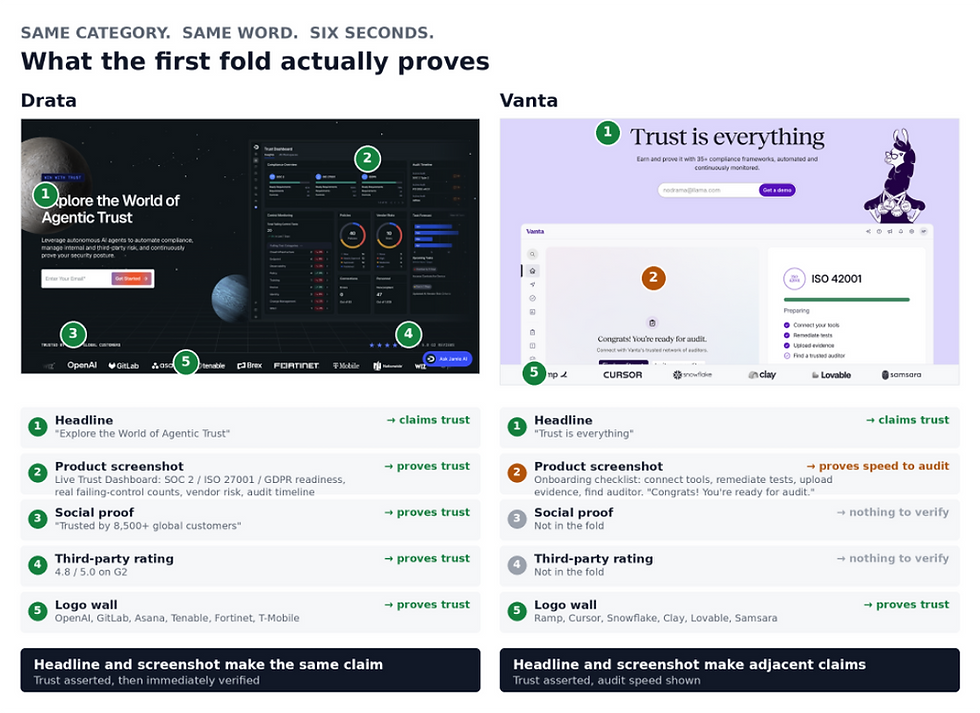
Drata's homepage opens with "Explore the World of Agentic Trust" next to a live-looking Trust Dashboard: SOC 2, ISO 27001, and GDPR readiness percentages, a control-monitoring panel with real failing-test categories, a vendor-risk breakdown, an audit timeline. Underneath: "trusted by 8,500+ global customers," a 4.8/5 G2 rating, and logos like OpenAI, GitLab, Asana, and T-Mobile. Every element is doing the same job: turning "trust" into something you can verify by scrolling, not something you have to take their word for.
Vanta's homepage opens with "Trust is everything," a well-designed hero, and a product screen underneath showing a checklist: connect your tools, remediate tests, upload evidence, find a trusted auditor, capped with "Congrats! You're ready for the audit." It's a real product doing real work, but the story it tells is "we get you through the audit faster." That's a feature of trust. It isn't the belief itself.
Buyers don't believe assertions. They believe evidence they can check themselves. Saying "trust is everything" is an assertion. A dashboard showing real failing-control counts and a live audit timeline is evidence.
And the gap between those two shows up in revenue, not just aesthetics. Product Marketing Alliance's State of Product Marketing report found companies with a dedicated PMM function are 2.3x more likely to meet or beat revenue targets than those without one. Research on product and marketing alignment points the same direction, with tighter alignment shortening time-to-revenue on new launches by close to 28%. None of that comes from content output. It comes from whether your narrative and your product tell the same story before a prospect ever talks to sales.
A fold like Drata's doesn't come from an execution hire
Someone decided that the dashboard would be the hero image instead of a stock illustration. Someone got engineering to expose real failing-control counts on a marketing page. Someone chose "agentic trust" over the safer, vaguer headline three people in the room preferred. That is the work, and it happens before a single asset gets written.
This is where most founders lose the growth lever they thought they were buying. They finally invest, open a founding PMM role, and hire someone with 5 to 7 years of experience. Strong operator, great at launches, enablement, competitive positioning. Then hand them a backlog and ask them to execute.
Nobody answered the question that comes first: which lever are we indexing on, and why that one. Answering it takes customer discovery, honest loss analysis, the pattern recognition to know which beliefs actually move a category, and the standing to tell a founder that the story they pitch investors isn't the story the market is buying. That last part is the real gate. It's not an experience problem, it's an authority problem. A PMM with five years of experience cannot walk into your leadership meeting and say the positioning is wrong, and even if they do, nobody will listen.
Founders, this one is on you
Marketing leaders can build the case, run the audit, and prove the numbers. But the belief a company organizes around is a founder-level decision, and it gets made whether or not you make it deliberately. If you don't choose it, your homepage, your sales team, and your roadmap will each choose a slightly different one, and your buyer will feel the inconsistency without ever naming it.
This is where you can begin today

Discover your belief with a product marketer experienced enough to challenge it, then build a narrative that carries it through every layer of your company.
Sources: Drata and Vanta homepages, screenshots as of August 2026. Product marketing revenue statistics via Product Marketing Alliance, State of Product Marketing Report 2025 and related industry benchmarking.


Comments