The Founder's Guide to Product Marketing

Most founders in the early stages of their journey are building toward product-market fit. And the journey from idea to product-market fit is rarely linear.
PMF isn't a switch you flip. According to First Round's framework, it's a progression through four levels — nascent, developing, strong, and extreme — across three dimensions: customer satisfaction, demand, and efficiency.
What you unlock as you climb is repeatability.
You progressively understand who the right customer is, what problem matters to them, how to reach them, and how to deliver value without reinventing the product for every customer.
Product marketing sits inside that journey.
But we often describe product marketing by its outputs: positioning, messaging, launches, sales enablement, customer stories.
Product marketing doesn't mean the same thing at every stage of a company.

Product marketing can play a different role at different stages of a company. It sits at the intersection of the product, the customer, and the market. Its job is to create clarity around three fundamental questions: who you are serving, what problem you are solving, and how you solve it differently or better than what they do today.

Before PMF, it may mean understanding the customer and sharpening the problem you're solving. As you find traction, it becomes about turning those learnings into positioning and a repeatable story. As you scale, it becomes the connective tissue across Product, Demand, Enablement and Customer.
The right role for product marketing depends on the question your company is trying to answer. A founder searching for PMF has a very different problem from a company trying to scale a repeatable GTM motion. So before asking what a PMM should own, first identify where your company is in the journey.

Stage 1: Pre-PMF: Founder as the first PMM
You're already doing this without calling it that — talking to customers, testing the problem, working out what they do today and what you might replace. It isn't about launches or campaigns yet. It's about whether you're solving a meaningful problem for the right customer.
Customer → Problem → Alternative → Evidence

Caveat:
Founders often don't spend enough time understanding the alternative. What are your target customers doing today to solve this problem? What does their current workflow look like without a solution like yours?
That as-is state matters because it helps you understand the cost of not changing, what makes the problem urgent, and what your product actually needs to displace.
Tip:
Build a habit of capturing your customers’ language, not just your notes. Record discovery calls, analyze them for recurring themes and phrases, and pay attention to how your buyers describe their problems on LinkedIn and other channels.
Stage 2: Searching for PMF: Experienced PMM expertise alongside the founder
Once you have an MVP, signals arrive. Some customers love it. Some use it in ways you didn't expect. Some prospects vanish after the demo.
At this stage, it isn't enough to collect feedback. You need a way to turn those signals into hypotheses you can test.
You need to understand what is happening across the buying journey, where prospects move forward or drop off, and what might explain those patterns. That means documenting the journey, tracking the right metrics at each stage, and building hypotheses around who is most likely to buy, why they buy, and what triggers the decision.

The goal is to shorten the feedback loop between the market and the product, moving from intuition to evidence.
Where an experienced PMM adds value
This is where an experienced PMM can work alongside the founder.
Their value is not simply collecting more customer feedback. It is bringing structure and an outside perspective to turn early signals into market hypotheses, combining what you're hearing from customers with patterns across the market, competitors and buying behaviour.
An experienced PMM helps you separate signals from anecdotes: what are we actually testing, what evidence would validate the hypothesis, and what would tell us to change direction?
The goal isn't to get the hypothesis right immediately. It's to create a faster, more disciplined path from what you're hearing in the market to what you decide to build, position and sell.
Caveat
Don't confuse collecting customer feedback with learning from the market.
Without explicit hypotheses, every request can become a use case, every objection can become a feature, and every enthusiastic customer can start looking like your ICP. The hypothesis gives your learning process a direction.
Tip
Create a simple hypothesis tracker. For each hypothesis, capture:
What we believe → Why we believe it → What would prove it → What would disprove it → What we learned → What changes
Stage 3: Initial PMF → Repeatable growth: Experienced PMM sets the foundation, founding PMM scales it
You've found customers who value the product. You now have a clearer understanding of your ICP, the problems that matter, and where you win most consistently.
But that knowledge is still largely owned by the founder. The founder is driving every prospect call, sales meeting and marketing decision: who to target, what to say, which problem to lead with, how to handle objections, and how to close.
That adaptability helped you discover the market.
Now it becomes the constraint.
The question is no longer:
Can we sell this?
It is:
Can we make what works repeatable without the founder being the system?
Set the foundation. Then scale it.
An experienced PMM works alongside the founder and leadership team to turn what you've learned into a strong strategic foundation:
ICP → Positioning → Differentiation → Messaging → Core narrative
Their role is to pressure-test assumptions, bring pattern recognition, develop a strong point of view, and align leadership around the story the company wants to own.
The founding PMM then takes that foundation and makes it transferable across personas, industries, use cases and customer touchpoints.

Experienced PMM brings customer, market and competitive insight into the strategy. Founding PMM translates the decisions into messaging, launches and sales enablement.
Caveat
Hiring a founding PMM without a strong foundation can result in more assets without more repeatability.
A strong foundation takes experience. You need someone who can work with the founder and leadership to challenge assumptions, build a strong POV, make the strategic choices explicit, and get leaders aligned behind them.
Tip
Before handing the story to a founding PMM, make four decisions explicit:
Who we win with → Problem we own → Why we win → What we want to be known for
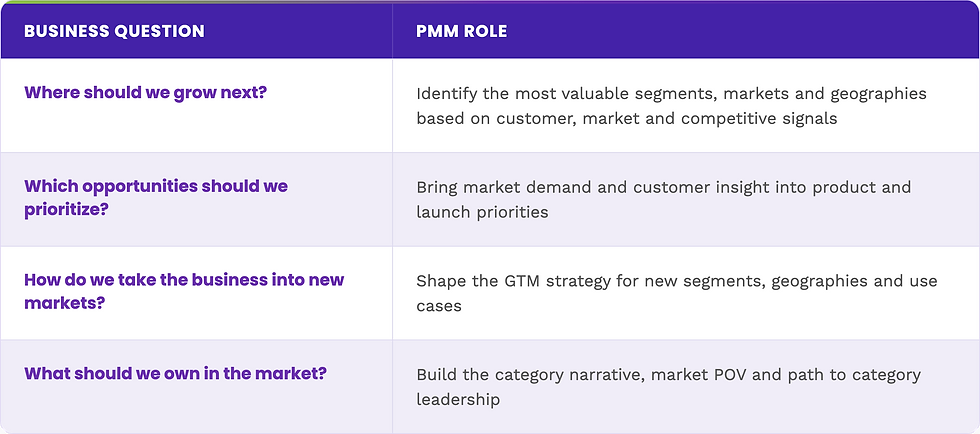
Stage 4: Growth → Scale: PMM becomes a strategic growth function
At this stage, the question is no longer “Can we make what works repeatable?”
It becomes:
“Where should we go next?”
The company has a working product and a repeatable motion. Now the decisions become broader and more consequential.
Caveat
As the company grows, PMM can easily become a catch-all for every go-to-market problem.
The function should stay anchored in strategic choices, not become an execution layer for every team.
Tip
Create a regular Market + Product review that brings together customer insights, segment performance, competitive shifts, product priorities and upcoming launches.
The goal is to keep one loop connected:
What the market is telling us → where we place the next bet → how we take it to market → what we want to own.
The bigger idea
Product marketing is about turning what you learn about your customers, product and market into clarity the business can act on.

That clarity shapes the decisions that matter: who to serve, what to build and prioritize, why you win, how to take it to market, and what to make repeatable.
And it empowers the moments that matter: launches, sales conversations, customer adoption and expansion. And when those pieces work together, they create business impact: more efficient demand generation, stronger pipeline conversion, greater product adoption and deeper customer relationships.
As the company grows, the role evolves, but the underlying job stays the same: turn understanding into clarity, and clarity into action.
So, the question founders need to ask isn't "Do we need a product marketer?"
It's:
What do we know about our market today that we need to make repeatable tomorrow?


Great read.